Nutcracker: A Distinctive Pattern Background Design System for Professional Creatives
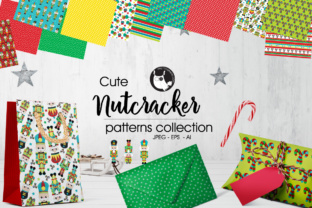
Nutcracker refers to a curated, high-fidelity pattern background design resource built specifically for designers, marketers, and small business owners who need visually cohesive, production-ready assets—without the time or technical overhead of building from scratch. Unlike generic pattern packs or algorithmically generated textures, Nutcracker is hand-crafted with deliberate rhythm, balanced scale, and intentional negative space. Its aesthetic falls cleanly between nostalgic charm and contemporary minimalism: “super cute” without veering into cutesy, detailed without sacrificing scalability, and warm without leaning overly sentimental.
What Sets Nutcracker Apart From Other Pattern Resources
Most pattern backgrounds fall into one of three categories: mass-produced digital downloads (often low-res or overused), custom-built vector illustrations (time-intensive and costly), or AI-generated repeats (lacking consistency in line weight, spacing, or motif logic). Nutcracker occupies a middle ground—designed by a professional illustrator, rigorously tested across real-world applications, and delivered with production-grade file integrity.
The distinction begins with intentionality. Each motif in the Nutcracker set—whether stylized nuts, miniature crowns, delicate gears, or interlocking ribbons—is drawn to repeat seamlessly *and* stand alone as a graphic element. That dual functionality matters when adapting assets across formats: a single motif might become a watermark on a presentation slide, a focal icon in an email header, or part of a tiled background on packaging.
File Structure and Practical Delivery
What you receive with Nutcracker isn’t just a collection—it’s a workflow-aligned toolkit:
- 1 EPS Vector File: Fully editable, resolution-independent, compatible with legacy and modern vector software. Ideal for print vendors requiring EPS or for users needing backward compatibility with older versions of CorelDRAW or InDesign.
- 1 Adobe Illustrator (.ai) File: Native, layered, and organized with named groups, color swatches, and non-destructive effects. Enables immediate customization—changing palette, adjusting stroke weight, or isolating motifs for recombination.
- Individually saved hi-res JPEGs (300 DPI): Each graphic element exported separately, not as a composite sheet. This eliminates manual cropping and ensures pixel-perfect fidelity for web banners, social media posts, or digital ad placements where vector support is limited.
This delivery model reflects how professionals actually work—not how stock platforms assume they should. It avoids the common friction points: having to trace low-res PNGs, ungrouping tangled layers in poorly structured AI files, or guessing whether a “seamless” pattern truly aligns at tile boundaries.
Comparing Use Cases: When Nutcracker Fits—and When It Doesn’t
Nutcracker excels in scenarios demanding both visual appeal and functional reliability. Consider these realistic examples:
- A boutique stationery brand launching holiday cards needs a background that feels festive but not clichéd. Nutcracker’s subtle nut-and-crown motif reads as celebratory without relying on snowflakes or Santa—making it viable beyond December and adaptable to gift tags, wrapping paper, or thank-you notes.
- A wellness startup designing a client onboarding kit wants cohesive yet approachable visuals. The soft linework and balanced density of Nutcracker patterns provide texture without overwhelming body copy—unlike busier damask or geometric repeats that compete for attention.
- An educator creating printable worksheets needs clean, scalable elements. Because each Nutcracker motif is vector-based and individually isolated, it can be resized to 8% for a corner accent or 120% for a header banner—no pixelation, no re-rasterization.
That said, Nutcracker isn’t optimized for every situation. If your project requires photorealistic textures (e.g., linen, concrete, brushed metal), it won’t substitute for high-res photographic overlays. If you need dynamic, data-driven patterns—like generative layouts that shift based on user input—Nutcracker’s static, hand-drawn nature is a limitation by design, not oversight. Similarly, if your team relies exclusively on Figma or Canva and lacks access to Illustrator or vector-capable tools, the .ai and EPS files offer less immediate utility—though the JPEGs remain fully usable.
Strengths, Tradeoffs, and Decision Factors
Strengths: Consistent motif language, true seamlessness across all tiles, intentional color harmony (palettes are built to work together, not just look nice side-by-side), and cross-format readiness. The “super cute” quality is achieved through proportion and restraint—not excessive embellishment—so it scales gracefully from tiny favicons to large-format wall graphics.
Tradeoffs: Limited stylistic range within the set. Nutcracker leans into its own voice—playful but precise—rather than attempting broad stylistic coverage. You won’t find grunge, cyberpunk, or ultra-minimalist variants here. Also, while the JPEGs are 300 DPI, they’re not provided in alternate resolutions (e.g., 2x for retina displays); users needing responsive web assets may need to resize manually.
Key decision factors:
- Intended output medium. Print-heavy workflows benefit most from the EPS and native AI files. Digital-first teams will rely heavily on the JPEGs—but should verify sizing requirements before purchase.
- Team technical capacity. If your designer regularly adjusts vectors, the layered .ai file adds significant value. If your team only inserts static images into templates, the JPEGs carry most of the utility.
- Brand alignment. Nutcracker’s tone sits comfortably alongside brands that value craftsmanship, warmth, and quiet confidence—think independent bookshops, artisanal food labels, or thoughtful edtech platforms. It contrasts sharply with aggressive, high-contrast, or corporate-modern aesthetics.
- Timeline and iteration needs. Because all elements are pre-tested and pre-aligned, Nutcracker reduces revision cycles. There’s no “will this tile correctly at 1440px width?” uncertainty—just implementation.
How Nutcracker Compares With Broader Pattern Design Approaches
Many designers begin pattern work by sourcing free SVGs, stitching together icons from disparate sources, or using online generators. While accessible, those approaches often introduce inconsistencies: mismatched stroke weights, irregular spacing, or motifs that don’t share a unified visual grammar. Nutcracker solves that at the source—by providing a system, not just symbols.
It also differs from subscription-based pattern libraries. Those offer volume but rarely cohesion; finding ten patterns that share the same x-height, line thickness, and visual temperature across thousands of options is inefficient. Nutcracker delivers a tight, focused set—designed to work *together*, not just exist alongside each other.
Finally, Nutcracker avoids the trap of “over-designed” patterns—those so intricate they lose legibility at small sizes or create visual noise behind text. Its motifs maintain clarity down to 12pt display size, making it viable for UI elements, app icons, or accessibility-conscious interfaces where contrast and simplicity matter.
Making an Informed Choice
Choosing Nutcracker isn’t about selecting the “cutest” option—it’s about selecting the most operationally sound one for your specific context. Ask yourself:
- Do I need reliable, production-ready assets—or am I still exploring visual direction?
- Will this support multiple outputs (print + web + social), or is it for a single, fixed use case?
- Does my current toolkit support vector editing—or do I primarily work with raster-based platforms?
- Is visual consistency across touchpoints a priority—or am I prioritizing variety and experimentation?
If the first three lean toward “yes” and the last leans toward “consistency,” Nutcracker aligns well. If you’re in early discovery, testing multiple styles, or working under tight budget constraints where free alternatives suffice for MVP stages, then Nutcracker may be premature—even though its quality is high.
Ultimately, Nutcracker serves professionals who value precision, efficiency, and tonal authenticity—not just decoration. It’s a tool for those who understand that background patterns aren’t filler. They’re silent collaborators in communication—shaping mood, guiding attention, and reinforcing identity, one repeat at a time.