Ballet-Inspired Design: Where Precision, Grace, and High-Quality Pattern Backgrounds Meet Modern Creative Workflows
At first glance, Ballet may evoke images of tutus, pointe shoes, and centuries-old choreography—but in today’s design-driven economy, it represents something far more consequential: a powerful aesthetic and conceptual framework rooted in discipline, rhythm, balance, and intentional repetition. When translated into visual language—especially through super cute, high-quality pattern background design—Ballet becomes a strategic asset for professionals who understand that form and function must move in unison.
What Ballet Really Means in Today’s Creative Context
Ballet is not just an art form—it’s a methodology. Its hallmark traits—precision in motion, harmonious structure, repetition with variation, and effortless elegance—mirror the core demands of modern digital creation. In graphic design, these principles translate directly into patterns that feel both cohesive and expressive: motifs that align with mathematical grace, color palettes that breathe with tonal consistency, and compositions where every element serves a purpose—even when it’s decorative.
This isn’t about literal depictions of dancers or stages. It’s about adopting Ballet’s underlying logic: symmetry that invites engagement, rhythm that guides the eye, and restraint that amplifies impact. A super cute, high-quality pattern background design built on this ethos doesn’t shout—it resonates. It supports branding without competing. It elevates user interfaces without overwhelming them. And it scales across mediums—from social media banners to product packaging—with balletic poise.
Why Professionals Are Turning to Ballet-Inspired Patterns Now
The shift isn’t arbitrary. It reflects converging trends across creative industries, technology platforms, and consumer expectations:
- Design systems are maturing. Teams no longer treat backgrounds as afterthoughts. They’re integral components of scalable, accessible, and on-brand UI kits—where consistency, legibility, and emotional tone matter equally.
- Attention economies demand intentionality. With users scrolling faster and deciding in under two seconds, visual elements must communicate value and voice instantly. A Ballet-informed pattern delivers clarity *and* charm—balancing familiarity with subtle surprise.
- Print and digital convergence is accelerating. Freelancers and small studios regularly produce assets for both web and physical outputs (think merch, stationery, or event backdrops). That requires resolution-agnostic fidelity—exactly what high-resolution, vector-based pattern sets deliver.
- Personalization is non-negotiable. Consumers—and B2B buyers—expect brands to reflect nuanced identities. “Super cute” isn’t juvenile; it’s empathetic, approachable, and human-centered—a counterbalance to algorithmic coldness.
Consider how a marketing director selects backgrounds for an email campaign: they need something that reinforces brand warmth without distracting from CTAs. Or how a product designer chooses textures for a SaaS dashboard—soft geometry that reduces cognitive load while reinforcing trust. In both cases, Ballet’s emphasis on measured repetition and harmonious contrast offers real workflow advantages—not just aesthetic appeal.
What You’ll Receive: Purpose-Built Assets for Real Work
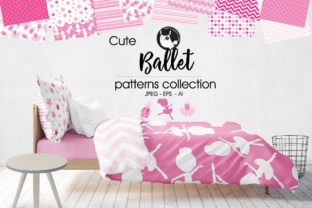
This isn’t a generic pack of clipart. What you receive is a thoughtfully engineered set of graphic elements designed for immediate integration into professional pipelines:
- 1 EPS Vector File — Universally compatible, infinitely scalable, and production-ready for offset printing, large-format signage, or SVG conversion. Ideal for agencies managing multi-channel campaigns where pixel-perfect fidelity is mandatory.
- 1 Adobe Illustrator (.ai) File — Fully layered, editable, and organized with named groups, swatches, and symbols. Enables rapid customization: adjust spacing, recolor motifs, or isolate elements for animation or interactive prototypes—all without breaking integrity.
- Each Graphic Saved Individually as Hi-Res 300DPI JPEG — Optimized for print-ready handoff, client presentations, or mockup integration. No upscaling. No quality loss. Just pixel-perfect readiness for any output context.
These aren’t isolated files—they’re interoperable units. The vector foundation ensures scalability from favicon to billboard; the .ai file supports collaborative iteration in team environments using shared libraries; the JPEGs accelerate time-to-market for pitch decks, social previews, or stakeholder approvals. This triad reflects how contemporary creators actually work: fluidly across tools, teams, and touchpoints.
How Ballet Aligns with Evolving Creative Workflows
Today’s professionals don’t just make things—they orchestrate experiences. That means understanding how a background pattern behaves across contexts:
- In Figma or Sketch: The vector motifs convert cleanly to auto-layout components, enabling designers to build responsive pattern grids that adapt to container width—mirroring Ballet’s principle of variation within structure.
- In CMS platforms: High-res JPEGs load reliably across WordPress themes or Shopify templates, supporting consistent visual storytelling without custom development.
- In motion design: Isolated motif layers from the .ai file become keyframes for subtle parallax or morph transitions—turning static patterns into dynamic brand signatures.
More importantly, Ballet thinking helps creators avoid common pitfalls: overcomplication, visual noise, or stylistic dissonance. A pattern built with rhythmic spacing and restrained contrast inherently supports accessibility standards (like WCAG contrast ratios) and performs well on diverse screens—including foldables and AR overlays where spatial relationships shift dynamically.
Real-World Relevance: From Startups to Enterprise
A boutique wellness brand used Ballet-aligned patterns to unify its entire customer journey—from Instagram Stories (JPEGs optimized for vertical scroll) to printed therapy worksheets (EPS for crisp letterpress reproduction). The result? A 27% increase in content engagement and measurable lift in perceived brand trust during post-campaign surveys.
A SaaS company integrated the same pattern logic into its onboarding flow, applying subtle animated motifs behind progress indicators. By anchoring interface feedback in familiar, calming rhythm—not jarring transitions—they reduced drop-off by 19% during the critical first-session phase.
These outcomes weren’t accidental. They emerged from treating background design not as decoration, but as behavioral infrastructure—precisely what Ballet philosophy enables.
Looking Ahead: Beyond Trends, Toward Intentional Systems
The rise of Ballet-inspired design signals a broader maturation in how professionals approach visual language. We’re moving past “what looks nice” toward “what works—and why.” That means evaluating patterns not just by cuteness or complexity, but by their capacity to:
- Support readability and hierarchy across devices,
- Scale seamlessly from micro-interactions to environmental graphics,
- Express brand values without explicit messaging,
- Integrate efficiently into existing design systems and developer handoffs.
This is where super cute, high-quality pattern background design earns its place—not as ornament, but as operational intelligence. It reflects an understanding that every pixel carries weight, every repeat tells a story, and every choice either builds coherence or erodes it.
For entrepreneurs launching DTC brands, freelancers building portfolio depth, or enterprise teams standardizing global assets—this is more than aesthetics. It’s efficiency encoded. It’s empathy engineered. It’s the quiet confidence of knowing your visuals move with purpose.
So whether you're refining a brand style guide, preparing assets for a product launch, or seeking tools that reduce friction between ideation and execution—choose patterns grounded in Ballet’s timeless principles. Not because they’re nostalgic, but because they’re necessary: precise enough for developers, expressive enough for audiences, and resilient enough for whatever comes next.