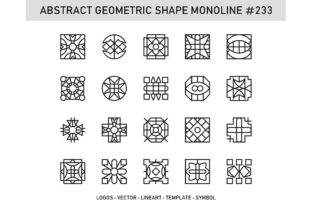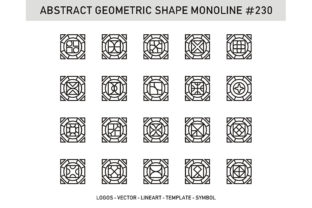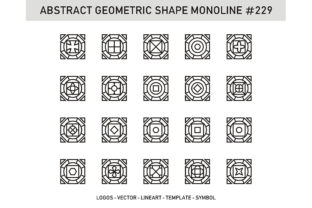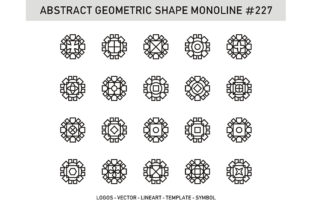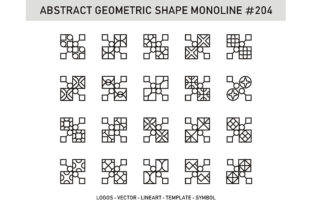
Abstract Geometric Shape Monoline 204
When you need clean, modern visual elements that communicate precision without clutter—Abstract Geometric Shape Monoline 204 delivers. It’s not just another vector graphic. This design is a single-weight, continuous-line abstraction: a balanced composition of interlocking angles and subtle curves, built with mathematical restraint and aesthetic intention. Its monoline structure means consistent stroke width throughout—no variation in thickness—making it exceptionally versatile across scales and mediums.
Why This Shape Fits Real Creative Work
Unlike ornate or highly stylized motifs, Abstract Geometric Shape Monoline 204 avoids visual noise while retaining distinct character. That makes it especially useful when clarity and neutrality matter—like in corporate presentations, educational infographics, or brand identity systems where the shape must support, not compete with, content. Designers report using it as a subtle background motif, a section divider in pitch decks, or even as a responsive icon base for SaaS dashboards.
Two Formats, One Purpose: EPS and JPG
You’ll receive Abstract Geometric Shape Monoline 204 in two complementary file types: an EPS file and a JPG file. Each serves a specific role—and understanding when to use which prevents workflow friction down the line.
- The EPS file is fully editable in vector-based software (Adobe Illustrator, Affinity Designer, CorelDRAW). You can scale it infinitely without pixelation, recolor individual segments, adjust anchor points, or combine it with other vectors. Ideal for logo development, print collateral, or motion graphics prep.
- The JPG file is high-resolution (300 DPI) and ready for immediate use in raster-based tools (Photoshop, Canva, PowerPoint) or web publishing. No setup needed—drag, drop, and go. Perfect for social media banners, blog headers, or internal slide templates where speed matters more than editability.
This dual-format delivery reflects how people actually work—not in theoretical “ideal” environments, but across mixed toolsets and shifting deadlines.
Where It Adds Quiet Value
Abstract Geometric Shape Monoline 204 shines in situations where consistency, adaptability, and professional tone converge. Consider these realistic applications:
- Educators embedding it into lesson slides to visually segment topics—its symmetry aids cognitive organization without distracting students.
- Freelance marketers building branded email templates: the shape works equally well as a watermark behind text or as a subtle bullet point replacement in feature lists.
- Small business owners designing product packaging inserts—its monoline nature ensures legibility even at 12 mm height on folded cardboard.
- Bloggers and content creators using it as a recurring visual motif across posts—readers begin to associate its rhythm with your editorial voice, reinforcing brand recognition over time.
Who Benefits Most—and Why
The strongest fit isn’t defined by job title—but by workflow reality. If you regularly move between vector and raster tools, manage tight deadlines, or serve audiences that respond to calm, confident visuals (think healthcare, finance, academic tech), Abstract Geometric Shape Monoline 204 aligns naturally. It’s especially helpful for those who’ve struggled with shapes that look crisp on screen but blur in print—or ones that scale well but lose their balance when resized.
That said, it’s not a universal solution. If your project demands bold contrast, illustrative storytelling, or organic texture (e.g., hand-drawn branding for a craft brewery), this monoline abstraction may feel too restrained. Likewise, if you’re working exclusively in Figma or Sketch and don’t have access to vector-editing software, the EPS file’s full potential won’t be accessible—though the JPG remains immediately usable.
Practical Tips for Getting the Most From It
Start simple. Try placing the JPG version at 15% opacity behind body text in a newsletter—it adds depth without competing. Then experiment: invert the color for dark-mode interfaces, layer it with a soft gradient overlay in Photoshop, or break it into three separate paths in Illustrator to animate each segment independently.
For long-term reuse, rename your files clearly: monoline204-eps-editable.ai and monoline204-jpg-300dpi.jpg. That small habit saves minutes later—especially when juggling multiple client assets.
And remember: this shape doesn’t need to dominate. Its strength lies in subtlety. One well-placed instance often communicates more than five crowded variations.
A Note on Contextual Fit
Geometric abstraction works best when it echoes something already present—whether it’s the grid layout of your website, the angular architecture in your product photography, or even the cadence of your written tone. Before inserting Abstract Geometric Shape Monoline 204, ask: does this reinforce what’s already clear? Or does it introduce a new visual language that needs explanation?
In practice, that means it pairs well with sans-serif typography (Inter, Helvetica Neue, IBM Plex), muted palettes (slate grays, warm taupes, deep navy), and generous whitespace. It resists pairing with highly decorative fonts or saturated gradients—unless that contrast is intentional and carefully controlled.
Efficiency Without Compromise
Time saved isn’t always about speed—it’s about reducing decision fatigue. With Abstract Geometric Shape Monoline 204, you skip the search for “something clean but not boring,” avoid licensing ambiguity (it’s royalty-free for commercial use), and eliminate the need to trace or redraw from scratch. That’s meaningful when you’re iterating on a client’s fifth round of presentation feedback—or building your third landing page this week.
One designer shared how using this shape as a consistent header element cut her template setup time by nearly 40%. Not because it’s flashy—but because it’s predictable, reliable, and never requires justification to stakeholders.
Final Thought: Precision Has Presence
There’s quiet power in geometry that feels intentional—not algorithmic, not arbitrary, but resolved. Abstract Geometric Shape Monoline 204 achieves that balance: minimal enough to recede, distinctive enough to register. Whether you’re refining a brand guideline, illustrating a complex concept, or simply choosing a background for your next webinar slide—it offers a grounded starting point. Not every design problem needs complexity. Sometimes, the clearest answer is a single, unbroken line—thoughtfully shaped, responsibly delivered, and ready when you are.