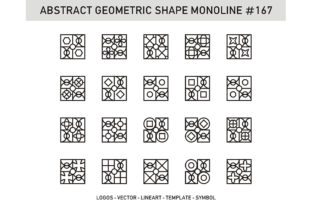
Abstract Geometric Shape Monoline 167: Clean, Scalable, and Purpose-Built for Modern Design Workflows
Abstract Geometric Shape Monoline 167 isn’t just another vector graphic—it’s a deliberate response to how designers, marketers, and product teams actually work today. At its core, it’s a single-weight, minimalist geometric form: precise, uncluttered, and built on consistent stroke geometry. Unlike ornate or illustrative assets, this shape prioritizes clarity and adaptability—making it equally at home in a SaaS dashboard icon, a brand identity system, or an educational slide deck.
Why Simplicity Is No Longer Optional—It’s Strategic
In an era where attention spans shrink and interface density grows, visual noise has real costs. Users scroll past cluttered layouts in under two seconds; stakeholders reject branding proposals that don’t communicate intent immediately. Abstract Geometric Shape Monoline 167 reflects a broader shift toward *intentional minimalism*—not as a stylistic trend, but as a functional necessity. Its monoline construction (uniform stroke weight, no fills, no gradients) eliminates ambiguity. There’s no guesswork about scale, contrast, or reproduction fidelity—whether viewed on a smartwatch screen or printed on a 48” trade show banner.
This isn’t about stripping away personality. It’s about distilling expression into structure. Think of how Apple uses subtle geometric cues in its interface language—or how Duolingo leverages clean, scalable icons across 40+ languages. These aren’t accidents of design. They’re outcomes of asset systems built around consistency, performance, and reuse. Abstract Geometric Shape Monoline 167 fits seamlessly into that logic.
How File Formats Shape Real-World Use
The availability of both .EPS and .JPG files isn’t just convenience—it’s workflow alignment. Each format serves a distinct, non-overlapping purpose:
- .EPS file: A vector-native format ideal for editing, scaling, and integration into professional design tools like Adobe Illustrator, Affinity Designer, or Figma (via import plugins). Because it’s resolution-independent, you can resize Abstract Geometric Shape Monoline 167 from a 16px favicon to a 10-foot mural without pixelation or quality loss. Designers use EPS files when building style guides, adapting logos for dark mode, or prepping assets for print vendors who require CMYK-ready vectors.
- .JPG file: A raster preview optimized for immediate use—embedding in presentations, sharing with clients who don’t have design software, or placing in CMS-based blogs or email newsletters. It’s delivered at high-resolution (typically 3000px on the longest side), ensuring sharp display on retina screens while remaining lightweight enough for fast web loading.
Crucially, neither file requires licensing negotiation or attribution. That matters for freelancers managing tight deadlines, educators preparing classroom materials, or small business owners updating their website banners over lunch. There’s no “asset procurement phase”—just download, place, and move forward.
Evolving Beyond Decoration: From Ornament to Infrastructure
Five years ago, abstract shapes were often treated as decorative flourishes—background textures, section dividers, or filler elements in mockups. Today, they’re increasingly foundational: part of design systems, UI component libraries, and even generative AI training sets. Abstract Geometric Shape Monoline 167 exemplifies this evolution. Its neutrality—lacking cultural symbols, literal references, or temporal styling—makes it interoperable across contexts. A healthcare startup can use it to imply connectivity in a patient journey diagram; a sustainability blog might repurpose it as a subtle motif in data visualizations about carbon flow.
This adaptability is amplified by technical discipline. The shape is constructed using Bézier curves with minimal anchor points—reducing file bloat and improving rendering speed in web environments. It avoids transparency layers or embedded fonts, which can cause inconsistencies across browsers or PDF viewers. In short, it’s engineered not just to look good, but to behave predictably.
Practical Uses Across Roles—and Where to Start
You don’t need to be a designer to benefit from Abstract Geometric Shape Monoline 167. Here’s how different professionals integrate it without friction:
- Freelancers & Agencies: Drop the EPS into a client’s brand kit as a secondary motif—pairing it with their primary logo to add rhythm without competition. Use the JPG version to quickly mock up social media headers in Canva or PowerPoint.
- Educators & Trainers: Insert the JPG into lesson slides to visually separate concepts (e.g., framing a key principle or signaling a transition between modules). Its abstraction avoids unintended associations—unlike clipart or stock photos that may carry unintended connotations.
- Bloggers & Content Creators: Apply the shape as a subtle watermark overlay on infographics or quote cards. Because it’s monoline and low-contrast, it adds branding presence without distracting from text or data.
- Product Managers & Marketers: Use the EPS to build consistent UI patterns—think toggle states, status indicators, or progress step markers. Its geometric precision ensures alignment across iOS, Android, and web implementations.
Start small. Try replacing a generic bullet point with Abstract Geometric Shape Monoline 167 in your next presentation. Or layer it behind a headline in a newsletter banner—scaled to 15% opacity for texture. These micro-integrations reveal its utility faster than theoretical analysis ever could.
Design Systems Are Growing—And So Is the Need for Modular Assets
More organizations are adopting design systems—not as static PDFs, but as living, shared repositories. In those systems, every element must be legible, editable, and version-controlled. Abstract Geometric Shape Monoline 167 meets that bar: it’s named clearly, delivered in universally supported formats, and built without hidden dependencies (no linked images, no missing fonts, no RGB/CMYK conflicts).
That reliability reduces friction for developers too. An EPS file can be converted to SVG with predictable path data—enabling CSS animations, responsive scaling, or dynamic color shifts via CSS variables. Meanwhile, the JPG offers fallback integrity for legacy platforms or email clients that don’t support SVG embedding.
A Note on Longevity—Not Just Trends
While some design motifs age quickly (remember skeuomorphism or heavy drop shadows?), monoline geometry endures. It appears in ancient Islamic tilework, mid-century Swiss typography, and contemporary app interfaces—not because it’s “in,” but because it solves recurring problems: legibility at scale, clarity under constraint, and harmony across mediums. Abstract Geometric Shape Monoline 167 doesn’t chase novelty. It leans into time-tested principles: balance, proportion, and restraint.
That makes it especially valuable for businesses planning multi-year brand roadmaps—or creators building portfolios meant to resonate across shifting platforms. You won’t need to “update” this asset annually. You’ll refine how you apply it.
Getting Started Is Literal Seconds Away
No registration walls. No email gates. No upsells. The download process is intentionally frictionless: one click for the EPS, another for the JPG. Both files arrive uncompressed, with clear naming conventions (abstract-geometric-shape-monoline-167.eps, abstract-geometric-shape-monoline-167.jpg) so they sort correctly in project folders and remain searchable across cloud storage or local drives.
Once downloaded, test it in context. Open the EPS in Illustrator and try recoloring it using global swatches. Drag the JPG into a Notion page and adjust its width to 80%. Paste it into a Figma frame and use it as a mask for a gradient. These aren’t hypothetical exercises—they’re reflections of how real users engage with assets daily.
Abstract Geometric Shape Monoline 167 works because it respects your time, your tools, and your intent. It doesn’t ask you to adapt to it. Instead, it adapts—quietly, reliably—to whatever you’re building next.