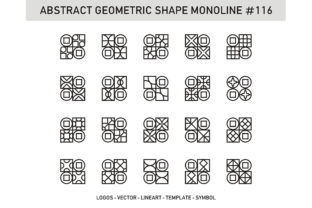
Abstract Geometric Shape Monoline 116
Abstract Geometric Shape Monoline 116 is a vector-based design asset consisting of a single-weight, continuous-line illustration that forms an abstract geometric composition. It belongs to a curated set of monoline patterns where visual rhythm, symmetry, and spatial balance are achieved through minimal stroke weight and intentional negative space. Unlike filled or multi-stroke motifs, this design relies entirely on the path of one unbroken line—making it inherently scalable, adaptable, and suitable for contexts where clarity and restraint are priorities.
Why Consider Abstract Geometric Shape Monoline 116?
Designers, branding professionals, and digital creators often seek assets that bridge aesthetic cohesion with technical flexibility. Abstract Geometric Shape Monoline 116 appeals to users who value clean visual language without sacrificing structural interest. Its abstraction allows broad interpretive use: it can function as a standalone icon, a subtle background element, a watermark, or a component within larger layouts. Because it avoids literal representation, it remains culturally neutral and temporally resilient—unlike trend-dependent illustrations that age quickly.
Its monoline construction also supports consistent rendering across devices and output methods. Whether scaled down to a 16-pixel favicon or enlarged to a 3-meter wall graphic, the uniform stroke weight maintains legibility and proportion—provided the file is used in its native vector format.
File Formats: EPS and JPG
The download includes two complementary formats: an EPS file and a JPG file.
- EPS (Encapsulated PostScript): A legacy vector format widely supported by professional design software such as Adobe Illustrator, CorelDRAW, and Affinity Designer. It preserves full editability—stroke paths, anchor points, and grouping remain intact. This format is essential if you plan to resize without quality loss, adjust stroke weight, recolor, or integrate the shape into layered vector compositions.
- JPG (Joint Photographic Experts Group): A raster format delivered at high resolution (typically 300 DPI or higher), suitable for immediate placement in non-vector workflows—such as PowerPoint presentations, web banners, or print-ready PDFs where editing isn’t required. Keep in mind that JPG does not support transparency and cannot be scaled beyond its native dimensions without visible pixelation.
Having both files offers practical redundancy: the EPS ensures long-term adaptability, while the JPG provides quick usability. However, the EPS remains the primary source for professional applications.
Key Benefits and Realistic Tradeoffs
Benefits:
- Scalability: As a vector, Abstract Geometric Shape Monoline 116 retains fidelity at any size—critical for responsive web design or large-format printing.
- Adaptability: Its neutral abstraction makes it compatible with diverse color schemes, typography pairings, and brand tones—no rework needed for stylistic alignment.
- Efficiency: Minimalist construction translates to small file sizes and fast loading in digital environments, especially when exported to modern vector formats like SVG.
Tradeoffs and Considerations:
- Limited expressiveness: The strict monoline constraint means no variation in stroke weight, texture, or layering. Users seeking dynamic contrast, hand-drawn warmth, or dimensional depth may find it visually restrained.
- Contextual ambiguity: Because it is abstract, it conveys no explicit meaning or narrative. It will not communicate industry-specific concepts (e.g., “health,” “tech,” or “education”) without supporting text or adjacent imagery.
- Editing dependency: While editable in vector software, basic adjustments—such as splitting the path or modifying individual segments—require familiarity with Bézier tools. Novice users may need time to learn how to manipulate the EPS effectively.
When Abstract Geometric Shape Monoline 116 Is a Strong Fit
This asset performs well in scenarios where simplicity, consistency, and scalability are functional requirements—not just stylistic preferences.
It suits brand identity systems aiming for understated sophistication, particularly for tech startups, creative agencies, or academic institutions prioritizing timelessness over novelty. In UI/UX design, it functions efficiently as a minimalist icon or decorative divider—especially where interface density must remain low. For print collateral, such as business cards or letterheads, its vector foundation ensures crisp reproduction on offset or digital presses.
It also integrates cleanly into motion graphics when animated along its path—revealing or tracing the line—as the single-stroke structure simplifies keyframe interpolation and reduces rendering complexity.
When Alternatives May Be More Appropriate
Consider alternatives if your project requires:
- Immediate visual storytelling: If the goal is to signal a specific concept (e.g., a leaf for sustainability, a circuit for electronics), a representational icon or illustrated glyph would communicate more directly than Abstract Geometric Shape Monoline 116.
- Textural or organic variation: Projects emphasizing tactile quality—such as artisanal packaging or editorial features—may benefit from hand-drawn lines, variable-weight strokes, or grain overlays that this monoline format intentionally omits.
- Multi-layered composition: If your layout depends on overlapping elements, shadows, gradients, or masking effects, a flat, single-path vector offers fewer built-in options than layered PSD or multi-object AI files.
- Web-first deployment with zero vector expertise: If you lack access to vector editing tools or need to embed the shape directly into HTML/CSS without conversion, an SVG version (not included in this download) would offer greater out-of-the-box utility than EPS or JPG alone.
Making a Practical Decision
To determine whether Abstract Geometric Shape Monoline 116 aligns with your needs, ask three questions:
- What is the primary function? If it’s structural (e.g., a repeating pattern, a framing device, or a scalable logo mark), its vector precision and neutrality are advantages. If it’s semantic (e.g., illustrating a process or representing a category), evaluate whether abstraction supports—or obscures—your message.
- Who controls the final output? If you or your team routinely work in vector environments and maintain design assets long-term, the EPS delivers lasting value. If usage is one-off and limited to static presentations or social media posts, the JPG may suffice—but verify resolution requirements first.
- How much customization do you anticipate? If you’ll need to recolor, combine with other vectors, or animate the path, confirm your software supports EPS import and path editing. If not, budget time for conversion or consider requesting SVG support from the provider.
Finally, compare it against similar monoline assets—not just by visual preference, but by technical attributes: number of anchor points (affecting editability), path continuity (critical for animation), and licensing terms (especially regarding commercial redistribution or derivative works). Abstract Geometric Shape Monoline 116 should be assessed as part of a broader toolkit—not in isolation.
Its strength lies not in universality, but in intentionality: it serves best when simplicity is a requirement, not a compromise.